About One DNP

I earned my "terminal practice" degree in nursing from the University of Tennessee Health Sciences Center in a journey of excitement and challenge. It inspired me to advocate for an all encompassing clinical credential rather than continuing the hodgepodge of nonsensical initials. I hope these entries will provide entertainment and insight into the Doctor of Nursing Practice experience, which will soon be the entry standard for all advanced practice nurses.

Tuesday, August 28, 2012

Serendipity: DNP Admission Essay


As Robert A. Heinlein put it in Time for The Stars: “Serendipity is when you dig for worms and strike gold.” This is what happened this morning as I was cleaning out my laptop files looking for a concept paper, but found my DNP admission application essay instead.  My nursing network has grown significantly in the past year and a number of folks are planning or in the process of applying to programs. While mine is psych/mental health focused, it might help provide inspiration for potential applicants. 


UTHSC DNP Application Essay 2009

“I’m not taking that disrespect medicine! And get these f*cking rent-a-cops out of here.”
“I respect you. These gentlemen are here for all of our safety. Please take the medicine.”
“Don’t you tell me what to do little girl. I know you just want to control my mind.”
“I just want you to rest and relax so you can speak to the doctor and get you home.”
“Bullsh*t!”
“Please make the good decision. If you take the medicine you can lie in bed and wait for the doctor. If you refuse we will have to put you in seclusion and maybe restraint. Which one do you think is more disrespectful?”
“Fine – give me the medicine.”
“Thank you.”

            When I relate this and similar encounters to my BSN students, they usually respond with a shudder and ask why I would ever want to work in a place like emergency psychiatry or in the psych field at all. They feel nervous around the unpredictability and worry about violence, sexual advances, and suicidal revelations. They are uncomfortable that the diagnosis of psychiatric illness cannot be confirmed with a lab value or imaging study and that there are no tactile tasks as there are in the medical setting. I tell them these are the exact reasons why I love working with this patient population and being a psychiatric and mental health nurse.
            After I came out of my accelerated BSN program in 2005, I took the advice of some nursing professors and began in the emergency department. It was not a good fit. I wanted to spend more time with patients than what was considered suitable for a department whose priorities were to stabilize and ship off. I had family ask if I could be their loved one’s nurse when they were transferred to ICU and I had individuals who had mania remember me as the nurse who took time to get to know them instead of locking them in a seclusion room just because they had “Bipolar” written in their history.
            I made the switch and took a position as a second shift nurse at Ten Broeck, a private psychiatric facility that catered to adults, children ages 3-12, and active duty military personnel. I also worked with the psychiatric assessment team that went to ER’s all over Louisville to determine level of care and initiate disposition to the appropriate facility. After two years I craved a higher acuity environment and more diverse patient population and took a position in emergency psychiatric services at University of Louisville Hospital. I also became certified through the ANCC as a psychiatric and mental health nurse and began teaching psychiatric clinical for Bellarmine University.
            In 2008 I began the Family Nurse Practitioner Program at Bellarmine. I chose the FNP because, while I love working in psych, I also wanted professional diversity. In addition to prevention, management and education of health conditions across the lifespan, a large percentage of primary care involves treatment of depression, anxiety, ADHD and PTSD and screening for substance abuse and domestic violence. Although I wanted more medical experience, I planned on obtaining my Psych NP certification even prior to beginning my FNP, and this resolve was strengthened during my educational clinical experience. While I enjoyed primary care in pediatric and adult settings, when I got to the psych portion of the rotation is was like a sigh of relief. With the new Doctor of Nursing Practice degree becoming a requirement in the next five years, I also feel it is important to continue my education while I am still in the flow of academia rather than waiting or being grandfathered in.
            In addition to nursing, I have also been an acupuncturist and Doctor of Oriental Medicine for the past ten years and have focused my practice in pain management, women’s health, and mental/emotional disorders. I have had the opportunity during my training and professional practice to work with chemical dependency, depression, anxiety, stress management and PTSD using a combination of modalities including acupuncture, herbal therapy, nutrition, Tui Na, exercise, and mediation. I was also involved in development of a research project that compared the effectiveness of CBT with and without acupuncture intervention in patients with PTSD.
            My professional goals include integrating my specialties to develop a holistic approach to education, prevention and treatment of anxiety disorders. While other disease processes such as bipolar, schizophrenia, and personality disorders are also of interest to me, in the higher levels of education I feel it is important to narrow the field of concentration. I have had experience in Internet blackboard courses and working at an accelerated learning environment while maintaining employment throughout my educational career. The ability to obtain the dual certification in mental health with the DNP allows me to have more freedom and a greater variety of choices to peruse my goals. 

Thursday, August 2, 2012

I Passed! A Review of the Review and Exam

In that which we are most confident often results in failure. At least, that was my fear going into the ANCC PMHNP certification exam. Despite hearing this exam was allegedly the easiest test I would take in the long series of nursing hoop jump-training, I did not want to get cavalier. Of all the boards I have taken, this was the most important and with hope, the last. As with my FNP, RN-BC, NCLEX, DOM, DilpAC, and DilpH preparation, I had a study plan, created a "cheat sheet" to write out on scratch paper before starting the test, and worried myself sick that I was a knowledge fraud who managed to graduate by luck or accident.

There is a DSM code for that.

After grabbing my usual eggs and lucky Indivisible Blend from Starbucks, I rolled into the parking lot of the testing center at 8:30am just in time to flip through every page of my review notes and psych myself up. After being ID'ed, wanded over, and searched for concealed textbooks, I was escorted to station 15 to live out the next 3.5 hours slugging through 175 questions, 25 of which were secret, experimental items that didn't count. 

Just 2 questions in and I was feeling nervous. By question 50, I doubted I was going to pass. By question 100, I had a boost of confidence. By question 125 I was trying to figure out if the 30-day test window would allow me to re-take the exam before Labor Day. By question 150 I just went numb and fuzzy. With a little over an hour on the timer to go, I ran back through the 45 questions I had marked, change a few answers, said a prayer, and hit submit. Five minutes later, I received the results and was officially certified! 

So, what was so hard?  This test had content that threw me for a bit of a loop. Unlike the Family NP exam that followed the "common diseases occur commonly" model of testing, the Psych Mental Health NP approach assumed you knew all the commonly occurring assessment and management of mood, personality, anxiety, and psychotic disorders and tested around it, with only a couple of bones thrown to topics like Lithium, psychosocial development, and dealing with a borderline in the milieu. 

There was a lot of neurobiology, pharmacokinetics and pharmacodynamics.  The time I put into neurotransmitter pathways, CYP450, and specific drug effects certainly paid off.  I did not spend as much time focusing in on the details of rating scales like the HAM-D, MMPI, and MMSE as I should have, though I was able to activate my hippocampus well enough to pull it out of my memory. There were a number of questions regarding collaboration and consultation, health policy, legal scenarios, and research. Knowing your role and scope was also included in several ways and folks who are FNPs need to be mindful - do not fall into the trap of treating or teaching beyond the scope of the PsychNP role.  There were a few obscure questions on nursing theorists and how to bill for certain procedures (had to be an experimental question). I felt my exam had an overabundance of child and adolescent content, yet not one questions on ADHD!

I used a number of references to prep for the test. 

The Barkley Review home study was an excellent content overview and helped my prioritize my study plan. Too often I go over what I already know to gain confidence and this helped me know what I really did not know. Copy for sale!

Kaplan & Sadock's Study Guide and Self-Examination Review in Psychiatry (STUDY GUIDE/SELF EXAM REV/ SYNOPSIS OF PSYCHIATRY (KAPLANS)
The MDs really like their background and history. Skip those chapters. NPs are more about the here and now of clinical management and interpersonal communication, which are well covered. Some of the questions reflect the essential differences coming from a disease versus a holistic-focus perspective, particularly when it comes to prioritization and adherence. The MDs go into greater depth than NPs when it comes to the "why," and this is particularly useful for psychopharmacology, etiology, and pathology. This book gives you a box of topics to review, several questions on content, and answers with rational.

Psychiatric Nursing Certification Review Guide for the Generalist and Advanced Practice Psychiatric and Mental Health Nurse, Third Edition (Mosack, ... Review Guide for the Generalist and Advance)
Content review is presented at the beginning of the chapter followed by questions. This does a great job going over the basics, which is invaluable for many PMHNPs who never worked in psych at the RN level or did not have experience during their clinical in group dynamics, milieu management, and staffing issues. Even if you are an old-pro, this one is still useful for the way the content blocks are organized, particularly policy and theory. These questions were most like what I encountered on the exam.

Psychopharmacology Demystified
If Stahl made a primer or Cliff's Notes version of Essential Psychopharmacology, this book would be it. The neuro content is well outlined with good visuals, no redundancy, and a clear picture how drugs work in the brain for the most common DSM disorders.

The Psychiatric Interview (Practical Guides in Psychiatry)
I referred to this a number of times while studying assessment. Great mnemonics for those that learn well that way.

Saturday, July 21, 2012

The Study Plan

After listening through the Barkley review with a mix of triumph and dismay at my knowledge base, it is time to dig into the source material. My test date is looming and it is time to see if I know what I think I know.  Sources are primarily the ANCC review book and a couple of the well-used texts from school, which I hope will result in a super-pass. Here is my life for the next few days:

Saturday: PMHNP role, scope, regulations, and theory

Sunday: Neuroanatomy, neurophysiology, behavior, and assessment of disease

Monday: Pharmacological principles and non-pharmacological treatment

Tuesday: Mood and anxiety disorders (apropos as I am getting a massage)

Wednesday: Psychotic and cognitive disorders

Thursday: Substance and personality disorders

Friday: Child/adolescent disorders and managing the dreaded yet interesting "other"

Weekend: Practice tests and reviewing the "know this cold" sections from Barkley review.

July 30th is the big day. Wish me success!

Friday, July 6, 2012

Authorizations and Dispositions

Getting Certified
I received my ANCC authorization to test. This is my last board exam ever, ever, ever. That is my official plan. I have less than a month to prepare and am using a combination of test preparation tools from both nursing and medicine. While the diagnostic and pharmacological facts remain consistent across disciplines, the differences in practice ideologies are immediatly evident just from the areas of focus and types of questions presented.

The psychiatric reviews by Kaplan and Saddock are heavy on etiology and pathology of the system with precision diagnostic differentials. The "why" of the diseases are given the greatest attention, as are the historical contexts of various disorders. Questions are posed first with rational presented later.  Well care and prevention are not highlighted though they are addressed in some sections.

The nurse practitioner reviews by the ANCC focus on manifestations of disorders in the individual, the therapeutic alliance, and holistic factors of treatment adherence and compliance.  The "how" of the diseases and interventions are given the greatest attention. Introduction to concepts are given first and questions later.  Neural pathways and biochemical aspects of disease and treatment are given some attention, but are not in-depth.

What it boils down to is what it always seems to boil down to: Treat the disease with medicine. Treat the person with nursing.

Potato. Potato.

Getting Employed
Of the three positions I applied for, I received one disposition letter informing me they chose someone else, than a notification letter for the same position stating I was still in the running. I received another notification letter for a different position informing me that I was qualified, followed by a disposition letter stating they hired another candidate. No word yet on the third position, but I should hear something one way or the other next week once the announcement closes.

While the clock ticks, I am working on my marketing-for-employment-to-do list. This includes exciting such as renewing several licenses and certifications, updating all of my online profiles, getting published by a journal that that allows a high-word count with several tables and figures without charging a reviewer fee, investigating the postings from a number of locum companies that have me on their list, and rebranding my private practice identity for my new expansion of scope.

Getting Zen
My July mantra: I will be exactly where I need to be, doing what I am supposed to be doing.


Saturday, June 23, 2012

Army Medicine Experience 2012

When the American Psychiatric Nurses Association asked me to represent them for the Army Medicine Experience Tour (AME12), I was both honored and thrilled. There have been three distinct times in my life when I considered joining the military. Once in high school when West Point invited me for a visit, second for ROTC during pre-med undergrad, and third for active duty Air Force after working as a PMH RN.  The options for learning were intriguing and the benefits tempting, however military service was not right for me at those times and I chose different paths. While I like who I am and where I am in life, I must admit this trip carried the"what if" factor for me.  The following reflections are just a few nurse-empowering highlights from AME12, an educational and rewarding experience not just from my perspective as a health provider, but as an American.

"Not everyone is meant to be a soldier" - Major General David L. Mann
The purpose of this trip was made clear early on - "Learn about your Army. . . get the word out so you are armed with the facts . . . this is not Mash 4007." We were recruited not to raise our own right hand, but to inform our spheres of influence about the benefits of working as a member of the Army healthcare team. Beyond the frequently advertised scholarships and loan repayment that come with service, Army healthcare providers described the deep sense of personal satisfaction and unique opportunities for professional development. While all providers may serve the public, those that serve soldiers exhibit an extra layer of pride and honor not replicated in the civilian world.

"We owe them the quality of medicine consummate with their service." - Herbert A. Coley

"We want people who are devoted to duty and high ideals" - Major General Robert J. Kasulke
Contrary to the idea that the Army will take anyone, only the most qualified providers and future providers are being recruited to care for our soldiers. There are over 9,000 health care providers serving in the Army, and the level of qualification is at a two year high. Competition for the Health Professions Scholarship Program is stiff and only the best are chosen to serve.


"We take care of America's sons and daughters." - Major General Jimmie O. Keenan
Rather than advancing her career as a Piggly Wiggly checker out of high school, Major General Keenan was one of the 1% of US citizens who raised her right hand. On choosing and chose to pursue a career in Army nursing, "it's about knowing what options are out there. I figured I would stay in as long as it was interesting. Its now 26 years later and I still bleed green" This 2-star general is chief of the Army Nurse Corp and Commanding General of the U.S. Army Public Health Command.  She presented all of us with her official coin during the farewell dinner which she assured us was not just so she could call out for it when in need of a free cocktail. She is one of the few people I have met who can say that they have it all.  A truly inspiring, authentic spirit!

"We rehab you for reality" - Brooke Army Medical Center
The nurse manager of the burn unit took us on a tour of the newly opened wing, and I re-learned a number of facts about vital signs, environmental protocols, caloric needs, and risk statistics. Nurses undergo a 6 month 1:1 preceptorship on the 40-bed unit (16 ICU/24 Step-Down) and are not considered experts for at least 2 years. The therapeutic alliances are much more personal than in other specialties, and professional boundary norms do not always apply. Due to the highly specialized nature of burns, many of the healthcare staff have been at this one post for a decade or more.  Stem cell skin regeneration is just one of the innovative therapies they are using to increase survival rate and functionality for burn victims.

"We have 3 missions: Patient care, training, and research. Not necessarily all in this building." - Center for the Intrepid
This facility has treated over 725 wounded warriors in the past five years using a number of high-tech modalities including Intrepid Dynamic Exoskeletal Orthosis (IDEO), FireArms Training Simulator (FATS), a made-from-scratch gait lab, and the largest Computer Assisted Rehabilitation Environment (CAREN) in the world.


"It's unfortunate it took 9 years of war to get here, but it is exceptional what they have done." - Specialist Christopher Powell
Our guest speaker from the Wounded Warrior project lost his legs to an IED while working as a medic in the field. This hero spoke to us the day before he was to get his first set of computerized knees. As a Psych nurse, I was particularly impressed that he engages in proactive, preventative counseling -  "I don't have PTSD or  TBI, but that doesn't mean I won't." Best of success in PA school!

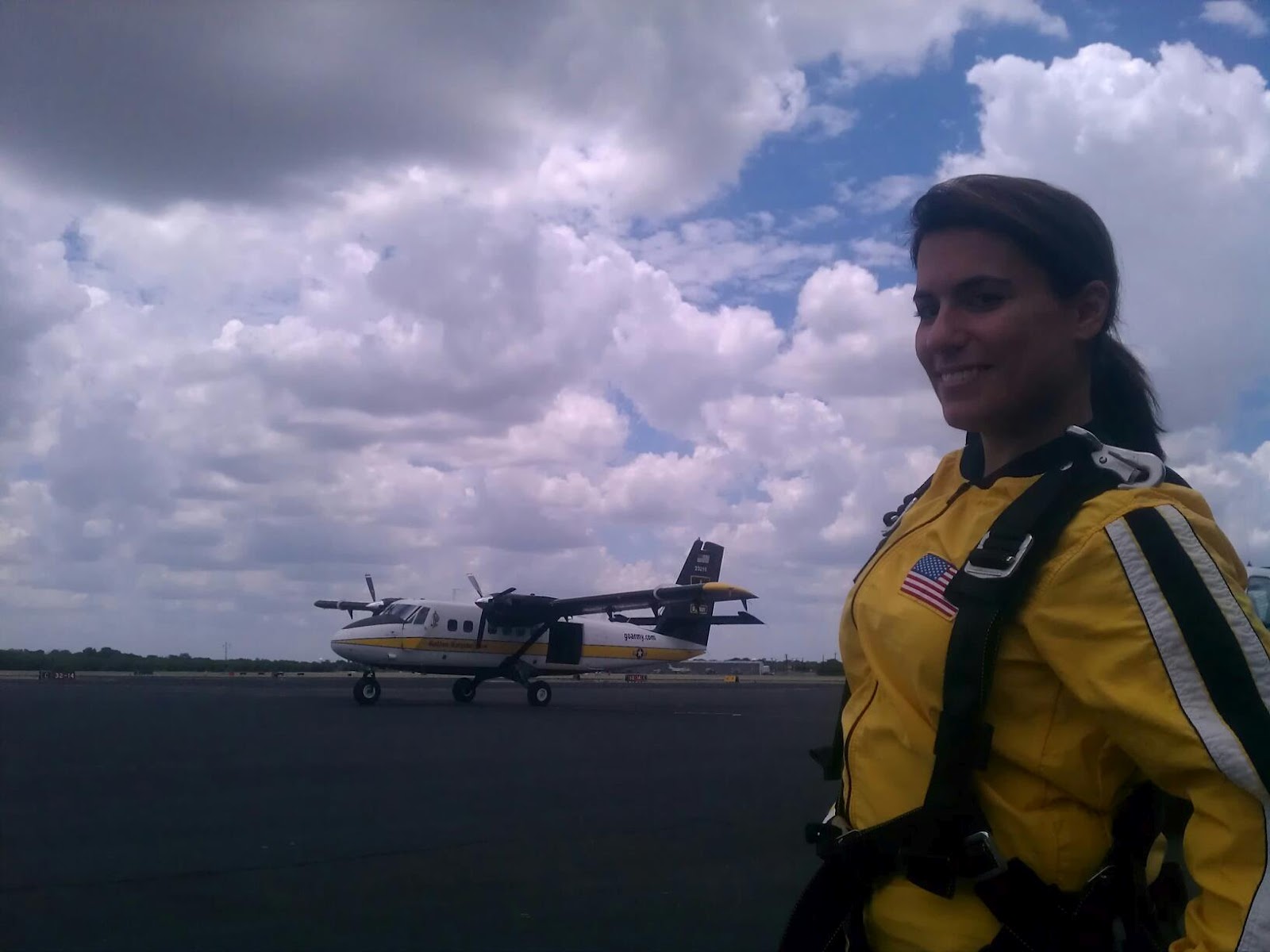
"It's kind of dangerous, but don't worry about that. Look good, have fun, and safety third." - Golden Knights
Major lesson: DO NOT WISH AWAY EXPERIENCES! I initially prayed for bad weather and a broken plane. Well, both happened right before it was my group's turn to go up. By karmic reprieve I was able to get on the manifest for the following day and had the experience of a lifetime! Check out the photos and videos for an external look at this incredible opportunity to jump with the Army's professional parachuting team, and my stab at a haiku to poetically describe the indescribable:

Wind rushing. Quiet
Falling. Abruptly floating.
Dream oblivion.


Thursday, June 14, 2012

Flying Providers!

This weekend I am off to attend the 2-day Army Medicine Experience Tour in San Antonio! Check out the list of the scheduled events with links to the highlights. For the latest updates, follow me on Twitter @OneDNP #AME12

Day One: Monday June 18th
0700: Welcome Breakfast with Major General David L. Mann
0900: Tour Brooke Army Medical Center and Center for the Intrepid at Fort Sam Houston
1245: Lunch at Fort Sam Houston Golf Course Club House with Major General Robert J. Kasulke
followed by Wounded Warrior presentation
1430: Army Medical Department Museum Tour and Army Medicine Q&A panel
1700: Experience San Antonio at will

Day Two: Tuesday June 19th
0600: Breakfast at will
0700: Depart for Stinson Airfield, Camp Bullis
0800: Tandem Jumps with the Golden Knights
1500: (if we survive) Health Professional Scholarship Program presentation, participant written reviews, film testimonials, and ravel claims
1930: Farewell dinner with Major General Jimmie O. Keenan


Friday, June 8, 2012

What Now?

The post-graduation elation has given way to the reality that I now have to use the education I have taken a couple of decades to acquire.  So, where does a DNP go from here?

For starters, I have to take the ANCC certification exam. Application was sent, the card was charged, and I am anxiously awaiting my approval to test. I will be provided a 90-day test window, and if all goes according to plan, I should be certified and licensed as an PMHNP in KY by August (and you know what I am going to do with that set of initials).  As soon as I get this piece of paper, I will create my study plan.

Next, a job. I already have my private practice doing what I do, but if I want to truly put theory into practice, I need to create my own psych-mental health residency in the form of employment. Thus far, I have ruled out MSN or DNP university positions. I have had interviews and opportunities, but frankly, the teachers I admire most are the ones that can back it up with a few years of clinical practice. As someone who preaches to my BSN students to "be the nurse you would want as your nurse," I have an obligation to "be the teacher I would want as my teacher." I am most interested in the VA and had an interview for a few positions this week. I did my own reflective journal on this, but will wait to hear one way or another before I post my thoughts on the experience.

The capstone is completed, and I want it published. Since the topic involved interdisciplinary research, it is a bit more difficult to find a home than it would be for straight nursing. I have a few ideas that I plan to explore this coming week.

Next week, I am jumping out of a plane with the Golden Knights as part of the Army Medicine Experience Tour at the Brooke Army Medicine Center.  The American Psychiatric Nurses Association  was kind enough to ask me to represent the organization and I am especially looking forward to learning about all the work they are doing with Traumatic Brain Injury and PTSD at the Center for the Intrepid.

Speaking of APNA, this September I was invited to take part in a task force on local chapter operations. I and a colleague will also be presenting a pre-conference session on integrating Traditional Chinese Medicine in the psych/mental health setting at the 26th annual convention in Pittsburg.

Phew, school might be over, but the learning and leadership is just beginning!


Sunday, June 3, 2012

Congratulations Doctor Nurses!

The degree journey has ended, but the DNP adventures are just beginning. As the responsibility for improving the future of healthcare was laid upon us, so was the realization that we all have the strength and knowledge to meet the challenges ahead. Here are some highlights from the convocation and graduation of the UTHSC DNP class of 2012!
Pre-Graduation festivities at a lovely Vietnam Restaurant with the largest, most diverse psych/mental health DNP class that was . . .  or ever will be.  


The faculty address by Melody N. Waller reminded us of the many dimensions of love and loss that come with the nursing profession. Hearing all of the great capstone projects my peers have been working on, especially with diabetes, vulnerable populations, and health promotion behaviors, was inspiring.

Hooded by Cheryl C Stegbauer, who gave me the best complement of my life during Philosophy of Science when she told me I was a thinker.


This Dr. Nurse was voted Class Troublemaker - expect great strides in mental health advocacy from this one! 
With two future Dr. Nurses who are destined for great advancements in integrative care!

After being handed my fake diploma  (actually a lovely picture of the campus),  Chancellor Steve J. Schwab shook my hand and said "Congratulations doctor. Well done."  He did this for the thousand-odd graduates after delivering an address exemplifying how our current knowledge will comprise just a fraction of our future knowledge in a career of life-long learning and innovation.

And so it is official!

Tuesday, May 22, 2012

The Big Day

For the sake of posterity . . . and in case I loose the instructions!


Graduation Instructions
College of Graduate Health Sciences
The Fed Ex Forum: May 25, 2012, 1:30 p.m.
1. The commencement program will be held in the FedEx Forum, located at 191 Beale Street.
2. Parking is available in the Forum parking garage or surrounding area lots.
3. Students, faculty and staff who are participating in the graduation program are requested to be at the Fed Ex Forum in the appropriate assembly area by 12:45 p.m.
4. The assembly areas are located on the lower concourse and are best reached through the main entrance. Once inside the lobby area, the elevators to the lower level are located to the right at the top of the steps. The areas will be marked with signs for easy identification. Only ceremony participants are allowed in the line-up area.
5. DON'T FORGET TO BRING YOUR CAP AND GOWN. Orders for academic regalia can be made in the UT Bookstore or by calling 901-448-5413. The regalia may be picked up in the Bookstore on the Wednesday and Thursday of graduation week.
The Line-Up and Procession
6. The class president is designated as the class marshal and is responsible for getting the class into the correct line-up. A faculty committee member is designated as the college marshal. The college marshal will have a name/number list indicating the beginning and ending person in each row. You should go to the class marshal for assistance in locating your line-up position. The correct line-up is critical to the issuing of diplomas and to the "hooding sequence." Please stay in position.
7. Tassels on the academic caps for all candidates should be worn on the right front quarter of the cap.
8. The procession is led by the Mace Bearer and leaves the assembly area promptly at 1:30 p.m. Each college will be led in the procession by the college marshal who will also assist in the seating procedure. Please remain in correct order.
The Seating
9. The correct seating order will be directed by the college marshals utilizing the name/number list. Seating is done two rows at a time. Fill up the entire row. The second person in line for the college must leave an empty seat for the banner carrier (the first person in line for the college).
10. Remain standing, the Chancellor will preside and ask for an invocation and the singing of the National Anthem. Following the National Anthem all persons should be seated.
The Charge
11. A “Charge to the Candidates” will be given.
The Conferring of Degrees
12. Each dean will present their candidates for the conferring of their degrees. Follow the instructions given by the Dean and the Chancellor.
13. Tassels will be moved from right to left at the direction of the Alumni Association President.
The Hooding and Diplomas
14. The dean of each college will call for the graduates in the college to rise and come forward to receive their diplomas and academic hoods.
15. Only the front row rises and proceeds to the stairs on the right-hand side of the stage. Follow the directions of the Ceremonies Committee members (in red tams). At the top of the stairs, stand in front of the "hooding box" facing the audience. After the hood is placed over your head, and on signal from the "hooder," step to the right and proceed to the center of the stage to receive your diploma from the Dean.
16. As you approach the Dean, receive your diploma with your left hand and shake hands with your right hand.
17.After receiving the diploma, continue across the stage and down the steps back to your row and seat.
18. As the last person in the row proceeds to the stage, the next row rises in unison in order that the first person in the next row may be ready to proceed to the stage. The previous row will sit, when the last person of that row has returned to their original seat. Do not leave the arena floor.
The Benediction and Recessional
19. Rise and men remove caps at the benediction. Replace cap and remain standing.
20. Recessional: Faculty and administration are led by the Mace Bearer and are followed by the graduates.
21. The recessional moves from the Forum floor back to the assembly/ gowning area. Please do not break the line and congest the recessional.
22. Caps, gowns, hoods and honor stoles must be turned in immediately following the ceremony in the gowning area.
23. Diplomas, in graduation jackets, will be distributed in the same area immediately following the recessional.
24. A photographer will be photographing each graduate as you are hooded and as you receive your diploma. Proofs of the photos will posted on the web site listed in the commencement program within a few days after graduation so that you may purchase copies, if you so desire.

Sunday, May 13, 2012

Capstone Update (with life thrown in)

Topping out at nearly 7236 words, 53 pages, and more tables and figures than I want to reflect on,  the culmination of nearly two years of work, Social Networking and Mental Health Providers:  Practice Trends and Perspectives to Shape Interdisciplinary Guidelines  has been submitted for subjugation to the red pen. Hallelujah!

Now, who wants to publish it?

For that matter, who want to come along for some travel and networking? In the past two weeks I had the opportunity to hob-knob with writers from the ASJA and entertain guests for Derby Week. Monday I am taking off for Las Vegas to attend the Contemporary Forums #Psych12 conference. The psychopharmacology units will be especially useful as I prepare for my ANCC psych-nurse practitioner boards. Graduation in Memphis comes the following week, then in June I will be attending the Army Medical Experience in San Antonio as he APNAs representative. For some reason I agreed to do a tandem jump with the Golden Knights which is perhaps a sign I need my dosage checked.

In the midst of all this fun come the job hunt and quandary over how best to use my new found genius. One one hand, I can continue to do what I have been doing - adjunct teaching and running a private practice 3-4 days per week.  The freedom is phenomenal and I love the variety of practice with teaching. Option two is to take up teaching on a full time basis with practice taking on more of a part time role. Benefits include . . . well, benefits, loan repayment, and the collaborative opportunities for research and speaking which do not come as a solo-provider. Option three is to focus on intensive clinical experience working with the VA (application submitted) while maintaining my practice on a part time basis. The advantage here is to hone my clinical skills with a population I enjoy working with in an area that is finally getting the funding it requires, and possibly the opportunity to ingrate acupuncture with PTSD treatment.

Any decision is a good decision and I will be able to apply the leadership skill I have learned throughout he DNP program.   Note that every scenario includes an element of private practice. I realized long ago I do not thrive in a 9-to-5-one-job environment.

My routine is variety. Except for sleep.