Presentation submitted and accepted for CEUs for the American Association of Nurse Practitioner's annual conference in New Orleans June 2015. I have to admit, I do think my working title "When Liquid Gold Goes Bust" was a smidge catchier. Here is a sneak-peak for those of you coming to AANP15 and for those of you who will be there in spirit.
Showing posts with label DNP Adventures. Show all posts
Showing posts with label DNP Adventures. Show all posts
Sunday, April 19, 2015


Sunday, November 23, 2014
AANP Abstract Accepted!
When I submitted my abstract, Counting Every Drop: Navigating Low Milk Supply, for consideration for the American Association of Nurse Practitioners 2015 national conference in New Orleans, I did not expect it to be accepted. Not only was this my first submission to AANP, but the conference presenters are the top of their field, and this topic is very much out of my daily professional expertise. I am surprised and honored to be selected as a podium presenter and to share the knowledge that I researched out of my personal struggles dealing with low-milk supply. Here is a look at my abstract submission:
Brief Bio
Dr. Jaclyn Engelsher is a Psychiatric Mental Health and Family Nurse Practitioner, and is nationally certified in Oriental Medicine. She has over a decade of experience blending allopathic and complementary evidence-based therapies for physical and emotional wellness.
Summarize why the topic is important
Current guidelines recommend exclusive breastfeeding for the first six-months of life, however many women are unable to produce adequate milk to meet this goal. Unlike initial difficulties or short-term factors that impact full supply, those suffering with chronic low-milk supply require a higher level of education, management, and support to increase or maintain production. The purpose of this presentation is to describe genetic, social, and emotional factors that contribute to low milk supply, and provide the practitioner with a summary of evidence-based allopathic and complementary interventions.
Summarize the literature on the subject
A review of the literature demonstrates up to 15% of women experience insufficient lactation, and 4-5% have chronic-low supply. The contributing factors can be categorized into issues of either production or extraction. Breast structure, previous breast surgery, certain medications, and pregnancy or postpartum complications contribute to production issues. Extraction issues may be related to feeding length and frequency, insufficient milk transfer, and incomplete breast emptying. Early detection and intervention with galactagogues, latch correction, and feeding or pumping optimization increase the likelihood of reaching full supply.
Summarize the focus of the presentation, such as management of condition, etc.
This presentation will provide evaluation strategies and review causes of low milk supply, including insufficient glandular tissue, infant lip and posterior tongue tie, postpartum difficulties, hormonal imbalances, diet, and emotional factors. Pharmaceutical, herbal, and food-based galactagogues, and lifestyle interventions such as feeding and pumping regimens, will be presented to help the practitioner identify appropriate management strategies. A list of patient education and peer-support references will be provided.
Describe the implications for practice, policy, education, and/or research
Low-milk supply evaluation and intervention has practice implications for the nurse practitioner specializing in pediatric, women’s-health, family, and mental health care. Differentiating transient from chronic supply issues, and early identification and management are key in choosing the appropriate intervention for the physical and emotional health of mother and baby.
Sunday, October 26, 2014
APNA14: You Can't Learn Mindfulness in a Weekend Workshop
Conferencing with an infant is certainly a unique experience! I had a blast reconnecting with many of my teachers and mentors while getting an infusion of professional and EBP goodness, though I must admit I missed my UT-DNP peeps. Every year I get to add to my list of memorable interpretive quotes and insights from the APNA conference, and APNA 14 was no exception. I am going to forgo an in-depth recap of this year's events and share some of my favorite gems. If you were there, you know who and where they came from!
I am already looking forward to APNA15 in Disney World - if it isn't the happiest place on earth when the psych nurses get there, believe it will be by the time we leave!
- We don't give enough credit to how difficult it is to be fully present
- Mindfulness is the antidote to mind wandering and time travel
- Nurses feel they have to be twice as good to be any good
- Perfect is the enemy of good
- Negotiation of difference is what we all have in common
- Assessment tools without the patient narrative assess very little
- In nursing, you can have a mid-life crisis every 7-years
- If you can't squeeze water out of a rock, don't blame the rock
- Nursing as a fall-back position is not exactly what you would call a career path
- I hope to have at least two more disclosures by the end of the month
I am already looking forward to APNA15 in Disney World - if it isn't the happiest place on earth when the psych nurses get there, believe it will be by the time we leave!
Sunday, October 6, 2013
APNA 2013 Poster
I have been on a writing hiatus. Between the new position at work and being 28 weeks pregnant, I am out of the habit of blogging. Though I would have really enjoyed doing a podium presentation again, I had a feeling it might have been more than I could tack on to an already packed schedule. . . as evidenced by the fact I just completed and ordered the hardcopy today and am leaving on Wednesday for the conference. This was really a fun one to research over the past few months, and I am looking forward to another great APNA conference. See you there!

Tuesday, February 26, 2013
Countdown to Vegas!
 |
| RIP 2006 |
We had our first beer on the flight up and I am pretty sure I stayed pleasantly inebriated for the entire trip. I remember his family felt guilty for the drama that made them want to run away and wound up coming anyway. The mentionable events that stick out:
- Walking the strip, thinking "I hope I can afford to stay at a fancy place like Treasure Island . . . how do families afford to stay here at $200/night?"
- Aerialists hanging from the ceiling at Ra in Luxor (now LAX) and finding myself in the center of the dance floor with a handsome partner and an attentive audience
- Going to the Stardust showroom to see if it was dark. Yep. To this day I often pack for my trips with Nomi Malone!
- The yellow brick road at MGM, a wizard sticking out of Excalibur, and general theming on the south side of the strip
- Carrying a cup of change with my whole $20 in gambling/drink tip money (I left with $16).
- Wait, the drinks are free?!?
- Seeing "Bottoms Up", the topless afternoon show at Flamingo where admission was only a $7 Heineken with coupon.
- Taking a ride on the Big Shot at Stratosphere
- Learning that marriage in Vegas is not the place for sentimentality. These people have a schedule to keep and your 30 minutes start the second you hit the dressing room (yet I still teared up!)
- Taking off at twilight and while we were taxiing down the runway, I gazed longingly at the strip as the lights came on, sad to be leaving but thinking, "I will see you later, Las Vegas strip. I will see you later."
While the strip has changed dramatically since that first visit, the vibe of Las Vegas holds the same promise of excitement, the same respite from everyday reality, and the same unpredictable wonder that keeps me coming back.
 |
| You woke up. Celebrate. |
So for those attending the conference who have never been to Vegas and for those reluctant to revisit, I have started board on Pinterest to help make the most of the free time you have have. And maybe even entice you to spend a couple of extra days exploring the Entertainment Capital of the World!
Sunday, December 2, 2012
VA Hiring Process
Prior to entering the DNP program, I knew I would have to make a choice between expanding my current private practice, or scaling back and seeking full time employment. I have derived an enormous amount of joy and freedom as an independent provider, and the practice has grown significantly despite an economic recession. However, an expansion in practice scope calls for major rebranding efforts that can result in more time, money, and emotional expense than starting a business from scratch. With the number of changes to health care coding and billing down the pike, and living in a state where we must have a collaborative (bribed) agreement with a physician to prescribe medications that are rightfully part of our independent scope of practice, I am not as bullish on private practice as I was a couple of years ago. Plus, it gets lonely working as a solo provider. I miss the camaraderie of coworkers and a stimulating environment that forces you to continually evaluate yourself as a provider, and challenges you to stay up-to-date on research, legislation, and best-practice.
Nurse practitioners have a lot of great options - some of my former colleagues have taken HRSA jobs in underserved areas, others are going academic, and some are like me. Just prior to graduation, I applied for positions in the VA after being encouraged by a few colleagues that are passionate about serving the veteran population. Having done the bulk of my clinical work with active duty soldiers, and being married to a (handsome, talented) veteran myself, it seemed like a natural fit for me. I was told the VA hiring process for healthcare workers can take a long time, and when I did some casual web surfing, I found the bulk of first-hand accounts came from LPNs and RNs. As a public service to anyone considering an advanced practice nursing career in the VA, I want to share my application and hiring process. Just keep in mind, "if you've seen one VA, you've seen one VA!"
April: I have a great conversation with a current NP who works outpatient and not only encourages me to apply, but provides excellent reassurance and advice regarding boards. Because I am already an FNP and will be eligible to take the PMHNP certification exam in 90-days, I quickly put in an application on April 24th to the one open position psych-NP, emergency and inpatient mental health consultations, to get my name in the system (open period 3/29-6/28). Had I been an RN only, I would not have applied until after graduation on May 25th.
May: I apply for 2 additional positions as they become available through USA Jobs, one on the 10th for an outpatient mental health clinic and the second on the 25th for the homeless veteran program (open period 5/7-9/17 and 5/18-6/18 respectively). In addition to the usual demographic questions, I was asked to provide my resume, 3 references, unofficial transcripts, a separate application for nurses/nurse anesthetists, declaration for federal employment, and copies of all licenses/certifications. Immediately after applying, the status in USAJobs is marked as "application received," and within a week they read "eligible - application referred to selecting official."
June: I have my interview on the 5th, which is conducted by 2 APRNs and 3 LCSWs. Before sitting down they joke about the formulaic nature of the interview, with each one asking standard questions in a round: "Why the VA?" Tell me about a time when you had a difficult patient and resolved it/collaborated for a positive outcome/had a conflict with an MD and managed it?," "What is recovery," "What is evidenced-based practice." Since I am also an acupuncture and Oriental medicine provider, they asked a few seemingly off-the-record questions about my practice. I also had a chance to ask them about why they chose the VA, involvement in national organizations, and what they do and do not love about working for the government. On June 12th, I am sent a disposition letter on the consultation position that another candidate was selected, and the status in USA jobs changes to "not selected." On June 20th I receive and official notification letter on the homeless veteran position stating "We have reviewed your application and found you qualified for the position listed above. Your name has been referred to the employing agency for consideration. THIS IS NOT A JOB OFFER."
July: This is where things get confusing. On July 3rd, I am sent an official notification email on the consultation position that states I am eligible (see above) and the status in USAJobs changes to "application referred." July 6th I am sent a disposition letter that I am not selected for the homeless veteran position. July 18th I am sent both the qualified notification and not selected disposition letters on the clinic job, then on the 30th I receive a notice that my application forms have been received and the USAJobs status changes from not selected to application received. I reach out to one of the APRNs, and am told that while my interview went well, they had an overwhelming amount of applicants who already had certification (my boards were scheduled for later that month) and/or were already VA employees. I am encouraged to keep my eyes out because more positions would become available.
August: All quiet.
September: Ten minutes from boarding a flight to London late in the month, I get a phone call from the VA telling me they would like to speak with me about an open position. After playing some telephone tag, it turns out the consultation position had been re-listed under a different announcement number. I speak with one of the mental health staff members responsible for finishing the hiring process who decides my previous interview is good for this position. I am tentatively given an offer pending credentialing, nurse professional standards board, and VetPro. Once that is all sorted out, I will be given an official offer. She cautions me that because I have to go through both nursing and mental health services the process can take awhile, and not to get caught up in Grade and Step, but to look at the salary and decide if I want to accept or negotiate. On the 24th I am sent the Qualifications Questionnaire with instructions to brag about my experiences as much as possible, because it can mean the difference of many steps and possibly a grade in overall pay. Up to this point, every person has been helpful and quick to respond to questions and concerns.
October: The first part of the month involves gathering and faxing documents, getting my physical, drug test, and fingerprinting done at the facility, and VETPRO. They anticipate I should be ready to start by November or December. I get a call late in the month informing me of my grade, step in salary, which is delightful. The process actually moved faster than expected, but as I have to give my private practice patients notice, I ask to start on December 3rd.
November: I receive my officially signed, in-writing offer letter dated for the 9th with instructions on where to go and what to bring for my first day of orientation. Hooray! I will have 2 weeks of orientation under nursing services before getting transferred to my official duty station in mental health services.
To sum up, from application to walking into orientation, it took 223 days (7 months and 9 days), though I could have started up to a month earlier if I did not have previous commitments to patients, conferences, and travel. Had I been certified as a PMHNP at the time I applied in April, I likely would have been hired initially and started within 90 days, give or take.
I have no plans to blog about my work at the VA from here on out unless it is relevant to nursing practice and complies with all the usual rules and regulations that come with working in government healthcare. As I have done all of this research and policy development on social networking for mental health providers, it would be utterly embarrassing to violate my own guidelines!
Tuesday, September 25, 2012
My First Task Force!: APNA State Chapter Operations
I had the privilege of being invited to a task force to
brainstorm methods of enhancing APNA chapter operations. The room was packed
with national board members, current and former state chapter presidents, and colleagues
and staff members I had previously only known through email or member forums. This meeting of the minds began with a few
key aphorisms:
“Opinions are not facts until proven”
“Loud and passionate people can be wrong” (can you say
“Facebook?!”)
“A camel is a horse designed by a committee”
Following brief introductions was a legal discussion on incorporation
status, state and local laws, chapter duties, tax exemptions, 501(c)
classifications, lobbying activities, and income categorization. If this sounds
dull, guess again. This presentation confirmed my suspicion some of the
activities of one of my other professional organizations has been performing
“substantial lobbying activities” and clarified the core purpose of APNA:
To be the unified
voice of psychiatric-mental health nursing
Well that’s nice, but how does that happen? Through value
propositions. APNA has identified 3 key
branding features:
- · Community (make me feel good as part of the crew)
- · Commitment (don’t screw me over and keep your promises)
- · Content (give me something meaningful that I can use)
In order to make the individual state needs merge with the
overall mission of the “mother ship.” Given that membership numbers have
doubled over the past 6 years and retention rates have risen by 15%, we are
doing quite well on the national level. State chapter involvement and
operations are more variable, and I am ashamed to admit I have not been as
active in Kentucky as I should be. The relationship with state chapters is
bidirectional – the national mission trickles down and tailored to apply to
local issues, while the individual state matters diffuse upward and are
encompassed by the whole. So how do we improve operations and encourage coalescence?
Our breakout group came up with 3 areas to focus our efforts and match our core
values.
Technology (Advancing
Community)
In addition
to our active member bridge, the APNA website offers a number of fantastic
tools and social media platforms to aid in chapter operations, however, the
technology is not utilized to it’s full potential and there are knowledge gaps
among members. Webinars, one-on-one tutorials during national and state
conferences, and use of virtual conferencing can bridge these knowledge gaps,
further connect the community, and disseminate information faster, more
comprehensive manner than previous platforms including mailers and email. There
is value in face-to-face networking and interpersonal communication (my
tutorial on bourbon with Bud Crouch would not have happened or been nearly as
entertaining in Go-to-Meeting) and technology should be used as an enhancement
and expansion, not absolute substitution.
ADVANTAGES: The efficient use of communication technologies
to disseminate information among members and increase communication among
individules, board members, chapters, and APNA national are significant
advantages. Platforms are continually developed to be more intuitive for ease
of use, which can help decrease generational gaps in knowledge. APNA has been diligent about keeping costs
low and maintaining an in-house staff of tech savvy individuals.
HURDLES: Maintaining
situational awareness of emerging technologies, providing education, and
performing outreach to members requires significant time investment. Resistance
due to reasons of privacy, lack of proficiency, and lifestyle are barriers for
engagement by members.
Standardization
(Preserving Commitment)
There are toolkits and staff available to aid in chapter
operations, yet there remains significant variability in many processes such as
meeting agendas, elections, and communication with APNA national. Clear,
concise, consistent guidelines for major chapter operations and functions
should be developed, but allow flexibility for local variation to expand on the
roles and goals of specific state issues.
ADVANTAGES: A common
ground for operations provides security for board members when they assume a
position and for all members to experience a consistent, organized environment
that will be familiar when visiting or transferring chapters. It prevents “reinventing the wheel” every
time a new board is elected so that time can be better spent on education,
advocacy, and networking.
HURDLES: With standardization change and a real or perceived
loss of control, particularly in chapters already active and well organized.
Coming to agreement on optimal balance of protocol and individuality is time
consuming with potential to be too vague or too rigid.
Recruitment/Retention
(Enhancing Content)
The big question for joining any membership with dues is
“what’s in it for me?” This can be
anything from personal recognition, CEU and professional development
opportunities, networking, discounts, collaboration, or professional updates.
APNA is supposed to represent all members, not just advanced practice members
or the most active chapters. While not an organization with a primary purpose
of political activism, more members input from mental health nurses in every
area of practice and all manner of nursing license is essential to provide the
most accurate representation of our interests as a whole.
ADVANTAGE: Participants active at the local and national
level become more competent, invested providers, which translate to better care
and advocacy for our patients. More
members result in increased ideas, greater reach of applicability for national
agendas, public awareness, and professional strength.
HURDLE: As an organization, membership and involvement have
been on an upward trend and this may not be the most urgent area to focus
chapter efforts. In a down economy,
membership dues may not bee viewed as a value-added expense.
Saturday, June 23, 2012
Army Medicine Experience 2012
 When the American Psychiatric Nurses Association asked me to represent them for the Army Medicine Experience Tour (AME12), I was both honored and thrilled. There have been three distinct times in my life when I considered joining the military. Once in high school when West Point invited me for a visit, second for ROTC during pre-med undergrad, and third for active duty Air Force after working as a PMH RN. The options for learning were intriguing and the benefits tempting, however military service was not right for me at those times and I chose different paths. While I like who I am and where I am in life, I must admit this trip carried the"what if" factor for me. The following reflections are just a few nurse-empowering highlights from AME12, an educational and rewarding experience not just from my perspective as a health provider, but as an American.
 "Not everyone is meant to be a soldier" - Major General David L. Mann
The purpose of this trip was made clear early on - "Learn about your Army. . . get the word out so you are armed with the facts . . . this is not Mash 4007." We were recruited not to raise our own right hand, but to inform our spheres of influence about the benefits of working as a member of the Army healthcare team. Beyond the frequently advertised scholarships and loan repayment that come with service, Army healthcare providers described the deep sense of personal satisfaction and unique opportunities for professional development. While all providers may serve the public, those that serve soldiers exhibit an extra layer of pride and honor not replicated in the civilian world.
"We owe them the quality of medicine consummate with their service." - Herbert A. Coley
"We want people who are devoted to duty and high ideals" - Major General Robert J. Kasulke
Contrary to the idea that the Army will take anyone, only the most qualified providers and future providers are being recruited to care for our soldiers. There are over 9,000 health care providers serving in the Army, and the level of qualification is at a two year high. Competition for the Health Professions Scholarship Program is stiff and only the best are chosen to serve.

"We take care of America's sons and daughters." - Major General Jimmie O. Keenan
Rather than advancing her career as a Piggly Wiggly checker out of high school, Major General Keenan was one of the 1% of US citizens who raised her right hand. On choosing and chose to pursue a career in Army nursing, "it's about knowing what options are out there. I figured I would stay in as long as it was interesting. Its now 26 years later and I still bleed green" This 2-star general is chief of the Army Nurse Corp and Commanding General of the U.S. Army Public Health Command. She presented all of us with her official coin during the farewell dinner which she assured us was not just so she could call out for it when in need of a free cocktail. She is one of the few people I have met who can say that they have it all. A truly inspiring, authentic spirit!
"We rehab you for reality" - Brooke Army Medical Center

 "We have 3 missions: Patient care, training, and research. Not necessarily all in this building." - Center for the Intrepid
This facility has treated over 725 wounded warriors in the past five years using a number of high-tech modalities including Intrepid Dynamic Exoskeletal Orthosis (IDEO), FireArms Training Simulator (FATS), a made-from-scratch gait lab, and the largest Computer Assisted Rehabilitation Environment (CAREN) in the world.
"It's unfortunate it took 9 years of war to get here, but it is exceptional what they have done." - Specialist Christopher Powell
Our guest speaker from the Wounded Warrior project lost his legs to an IED while working as a medic in the field. This hero spoke to us the day before he was to get his first set of computerized knees. As a Psych nurse, I was particularly impressed that he engages in proactive, preventative counseling - "I don't have PTSD or TBI, but that doesn't mean I won't." Best of success in PA school!
"It's kind of dangerous, but don't worry about that. Look good, have fun, and safety third." - Golden Knights
Major lesson: DO NOT WISH AWAY EXPERIENCES! I initially prayed for bad weather and a broken plane. Well, both happened right before it was my group's turn to go up. By karmic reprieve I was able to get on the manifest for the following day and had the experience of a lifetime! Check out the photos and videos for an external look at this incredible opportunity to jump with the Army's professional parachuting team, and my stab at a haiku to poetically describe the indescribable:
Wind rushing. Quiet
Falling. Abruptly floating.
Dream oblivion.
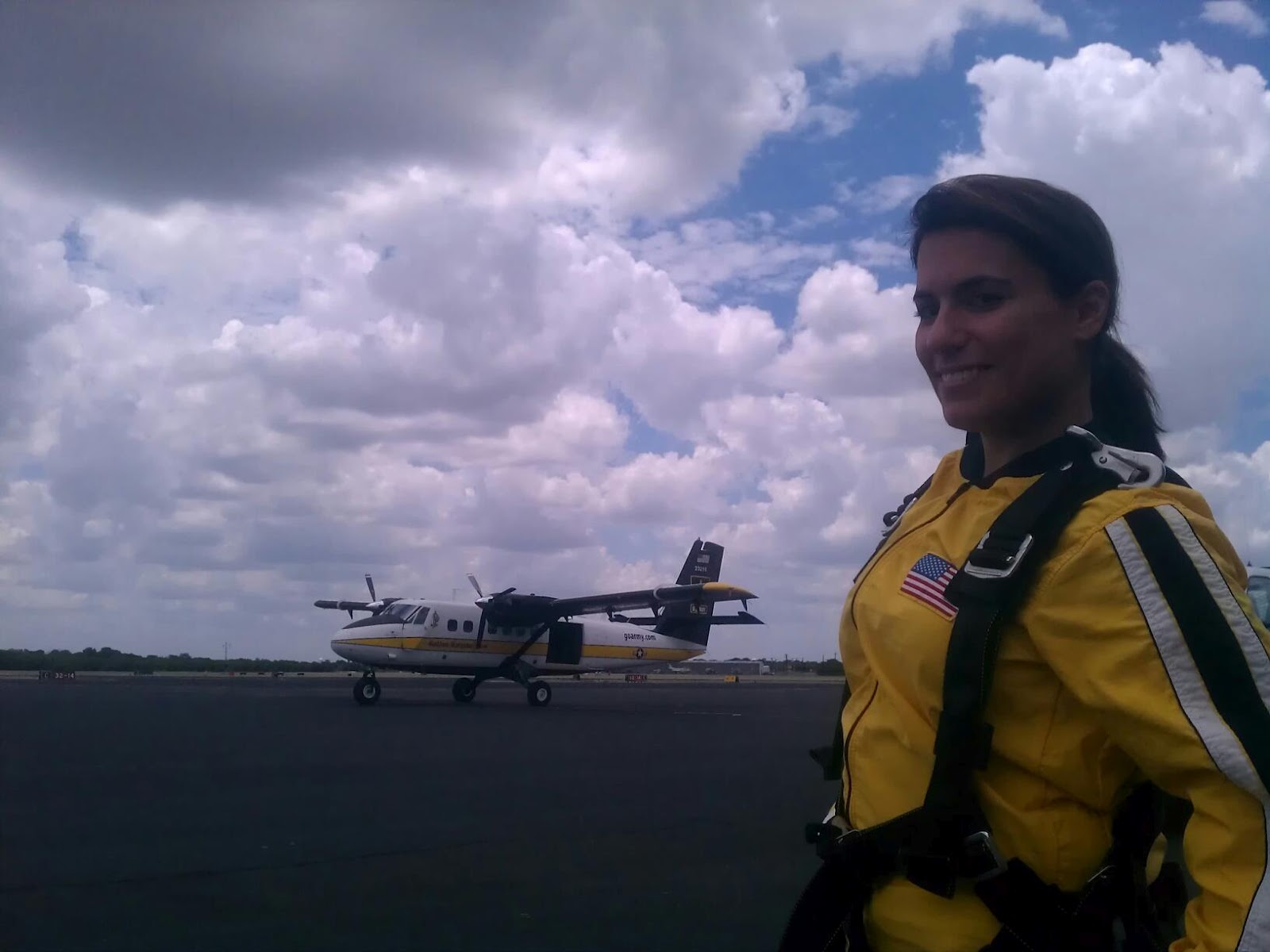


Thursday, June 14, 2012
Flying Providers!
This weekend I am off to attend the 2-day Army Medicine Experience Tour in San Antonio! Check out the list of the scheduled events with links to the highlights. For the latest updates, follow me on Twitter @OneDNP #AME12
Day One: Monday June 18th
0700: Welcome Breakfast with Major General David L. Mann
0900: Tour Brooke Army Medical Center and Center for the Intrepid at Fort Sam Houston
1245: Lunch at Fort Sam Houston Golf Course Club House with Major General Robert J. Kasulke
followed by Wounded Warrior presentation
1430: Army Medical Department Museum Tour and Army Medicine Q&A panel
1700: Experience San Antonio at will
Day Two: Tuesday June 19th
0600: Breakfast at will
0700: Depart for Stinson Airfield, Camp Bullis
0800: Tandem Jumps with the Golden Knights
1500: (if we survive) Health Professional Scholarship Program presentation, participant written reviews, film testimonials, and ravel claims
1930: Farewell dinner with Major General Jimmie O. Keenan
Subscribe to:
Posts (Atom)